Adaptive re-use: Demolish less. Earn more.
Insights | 19 May, 2026

Cities around the world are increasingly rethinking the traditional “demolish and rebuild” model. Instead, they are discovering the value of repurposing existing buildings, extending their lifecycle while preserving the cultural and material resources already embedded in them. But what does adaptive reuse really mean and why is it becoming such a powerful tool for the future of sustainable cities?
Adaptive reuse in Real Estate: faster returns, lower carbon, higher value
Adaptive re-use is no longer a “nice to have”; it’s a commercial advantage for workspace and retail investors and asset-owners. Reworking existing buildings can unlock value faster than new builds, cut carbon at scale, and get assets income-ready sooner. In workspace, character-rich, adaptable environments are proving more attractive to occupiers than generic spaces. In retail, adaptive re-use supports the shift toward mixed-use, experience-led destinations that drive footfall, dwell time, and diversified revenue.
Telefónica Headquarters, Madrid, Spain
The historic Telefónica Headquarters on Gran Vía is a powerful example of this approach. We transformed this landmark building into a multifunctional retail and cultural environment, balancing historic preservation with immersive digital experiences. The result is a destination where technology, community and brand storytelling intersect. Tenants want character, experience, and flexibility; and older buildings are well-placed to deliver all three.
Smart adaptive reuse: enhancing buildings without major reconstruction
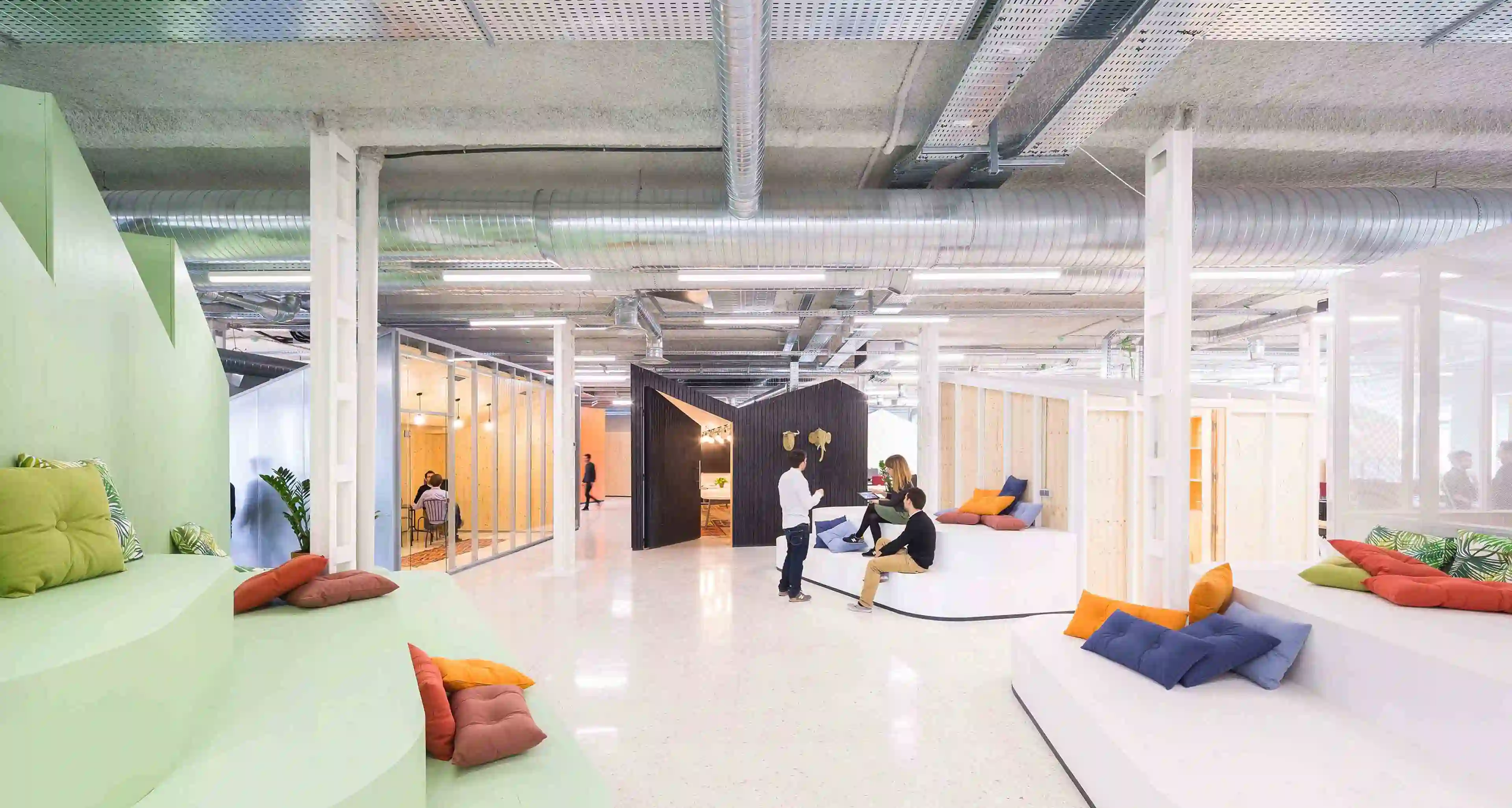
Yet adaptive reuse doesn’t always require transforming an entire structure. Often the most effective approach is architectural acupuncture: targeted, high-impact interventions that unlock a building’s potential with minimal structural disruption. By strategically improving circulation, social hubs, light access, and spatial connectivity, a building’s performance and user experience can be radically enhanced without the environmental and financial costs of a full reconstruction.
Rosenthal Mitte, Basel, Switzwerland
At Rosenthal Mitte in Basel, we revitalized a traditional laboratory and office complex through surgical spatial interventions. By introducing catalyst spaces and shared community areas, the project transformed a conventional building into a dynamic multi-tenant ecosystem designed to foster spontaneous collaboration, interaction and innovation.
But how to turn a smart investment into a smart building?
The smartest assets of the next decade won’t necessarily be the newest. Some of them will be the most intelligently re-used.
This is where Studio Banana comes in. We have 19 years of experience reimagining spaces where people work, learn, and thrive.